On this page
Quick answer: Winter greenhouse ventilation is a balance between removing moisture and retaining useful heat. Start by recording when and where condensation appears, what moisture entered before dusk, indoor and outdoor conditions, and whether intended vents or fans were operating. Then change one supported factor and compare the next similar event. Do not use one RH target, vent gap, fan runtime, or temperature cutoff as a universal rule.
This guide is for US hobby greenhouse owners dealing with cold-season condensation or damp air. It gives you a measured decision process, not a crop setpoint, disease diagnosis, heater plan, fan-sizing formula, or product recommendation.
Why winter ventilation still matters
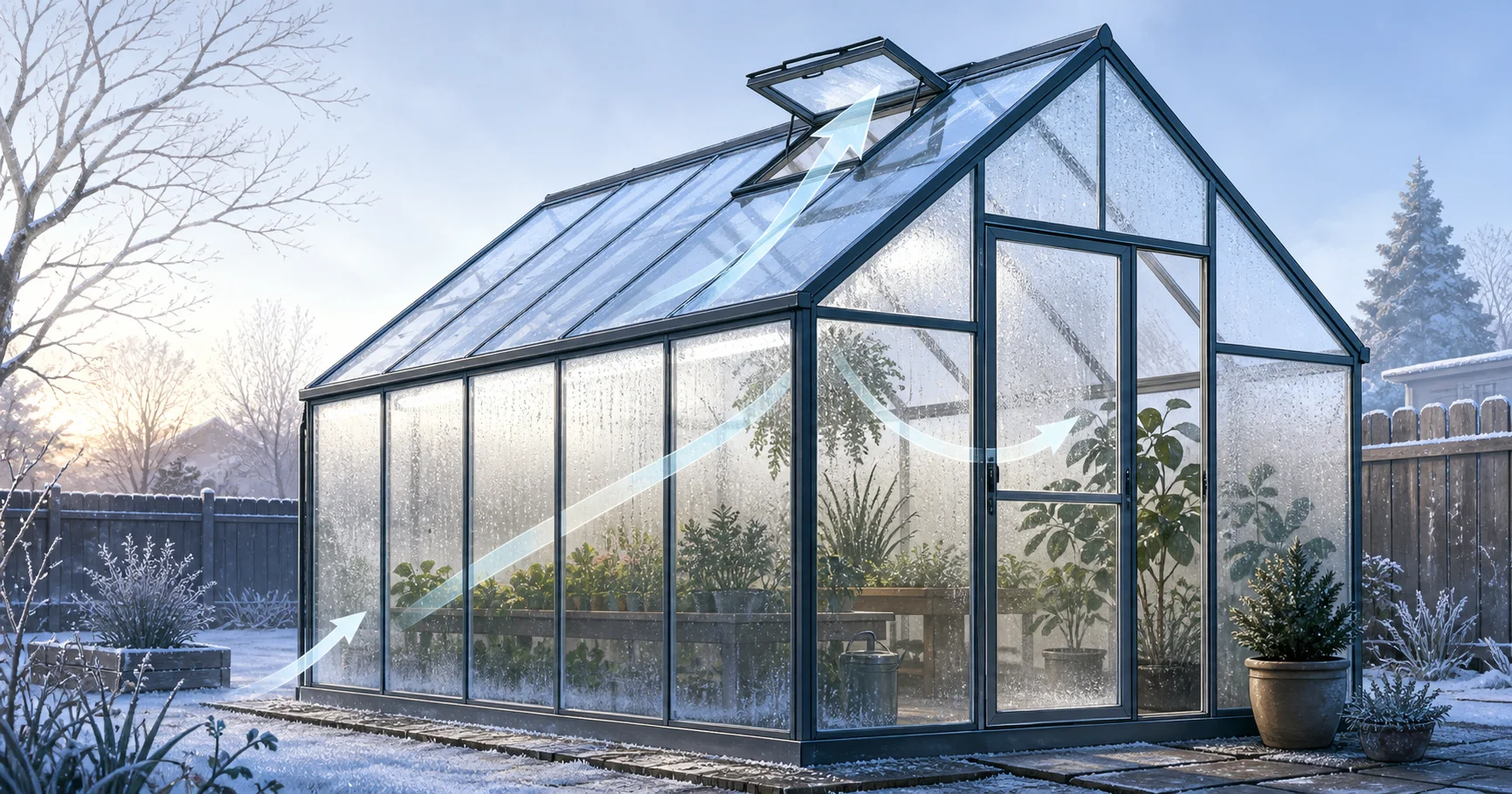
Cold weather does not remove moisture from a greenhouse. Water can enter through irrigation, wet surfaces, plant activity, leaks, and humid outdoor air. Utah State University Extension describes high humidity as a cold-season high-tunnel concern and discusses ventilation through doors or sidewalls as part of managing conditions. That Utah State Extension source applies to its high-tunnel and irrigation context; it does not establish one setting for every hobby greenhouse.
Heat retention creates the competing pressure. Opening an intended vent can exchange air, but uncontrolled gaps around doors, failed louvers, or inactive fan openings can add heat loss without giving you a predictable moisture-control path. Treat those as different problems: preserve useful ventilation, inspect unwanted leakage.
Read condensation as a clue, not a diagnosis
Record location and timing before choosing an adjustment. Water across glazing, water in one cold corner, wet leaves, and drip lines below framing do not identify the same mechanism. A single RH reading can also miss a colder surface or stagnant pocket where condensation begins.
| Observation | What it tells you | Next check |
|---|---|---|
| Most glazing becomes wet overnight | Moisture and surface cooling may involve much of the greenhouse. | Log moisture inputs, indoor/outdoor conditions, and intended ventilation state. |
| One corner or wall becomes wet first | A cold or poorly mixed pocket may be involved. | Compare temperature and air movement with the open plant area. |
| Leaves become wet before nearby glazing | Leaf surface temperature or a humid boundary layer may matter. | Check canopy density, circulation path, and whether leaves entered night wet. |
| Water follows a joint or framing line | Condensate may be collecting and moving from a colder surface. | Trace upward before labeling it a roof or irrigation leak. |
| Wetness returns after irrigation | Moisture input timing may be part of the pattern. | Record irrigation finish time, drainage, standing water, and later conditions. |
Use a one-week measurement log
One event can mislead you. Log similar observations for several days when practical, especially before making multiple changes. Use the same sensor locations and note when a reading may not represent a cold surface or plant-level air.
Seven-day winter observation log
Entries stay in this browser on this device. The log does not calculate a target or diagnose a cause.
Use the pattern, not one number: compare timing, location, moisture inputs, and equipment state. A repeated pattern supports the next inspection; it does not prove one cause.
Log interpretation: Compare timing and pattern, not one number. If the first wet location changes after one controlled adjustment, record that as new evidence—not proof that one cause has been confirmed.
Winter ventilation decision tree
- Is water or dampness recurring? If no, keep observing. If yes, record location, timing, moisture inputs, and equipment state.
- Is the moisture source obvious? Check irrigation timing, wet floors or benches, standing water, leaks, and wet plant surfaces. Correct only the source you can identify without guessing.
- Is intended ventilation operating as designed? Check the vent, louver, door, or fan instructions and operating state. Do not infer capacity or safe opening from a generic number.
- Is heat escaping through an uncontrolled path? Inspect door seals, failed louvers, inactive fan openings, and other defects separately from intended ventilation. Follow the relevant equipment and greenhouse instructions.
- Can you measure a repeatable pattern? Compare indoor/outdoor conditions, sensor position, wet location, and timing. If not, improve the measurement record before changing several controls.
- Does the pattern persist or involve an unsafe condition? Stop improvising. Use manufacturer documentation or qualified technical help for equipment, electrical, structural, heater, wet-location, or custom-vent questions.
Separate intended ventilation from uncontrolled leakage
Intended ventilation is a designed opening or device you can identify and operate according to its instructions. Uncontrolled leakage is a gap, failed seal, damaged louver, or inactive opening that changes heat loss and airflow without a reliable control decision. Penn State Extension energy-efficiency guidance treats infiltration and failed openings as heat-loss concerns, while also discussing airflow and humidity uniformity. That supports inspection of the path; it does not mean every opening should be sealed or every vent should remain closed.
When you find both problems, do not solve them with one action. Preserve the intended path, address the defective path using the applicable instructions, and keep logging. This distinction prevents “seal everything” and “open everything” from becoming automatic advice.
Common winter mistakes
| Shortcut | Why it fails | Better next move |
|---|---|---|
| Chase one RH number | One air reading may miss colder surfaces and local pockets. | Log RH with temperature, location, timing, and sensor position. |
| Open every vent overnight | May increase heat loss or add little useful drying under current outdoor conditions. | Use the decision tree and equipment instructions. |
| Seal every gap | May remove intended ventilation or hide a failed component. | Classify intended openings and uncontrolled defects separately. |
| Run a fan by a generic schedule | Runtime and airflow depend on system capacity, openings, leakage, and conditions. | Use the fan-sizing and control guidance for the actual system. |
| Call condensation a disease | Wetness is an observation, not a diagnosis; Penn State Extension also treats leaf wetness as one factor in greenhouse disease-risk assessment, not as a diagnosis. See the disease-risk checklist. | Inspect moisture, surface, airflow, crop, and evidence separately. |
When this guide is not enough
This process cannot choose crop setpoints, diagnose a disease, size a heater, calculate fan runtime, confirm structural capacity, approve wiring, or prove a custom vent is safe. Stop and use exact manufacturer instructions or qualified help when the question involves electrical exposure, combustion, structural changes, wind or snow loading, wet-location equipment, or a persistent fault you cannot isolate.
For broader context, see the greenhouse ventilation guide. For condensation mechanisms, use the greenhouse condensation guide. When sensor position may be distorting your readings, use the temperature sensor placement guide. For staged control decisions, use the greenhouse temperature control guide.
Sources and methodology
This article synthesizes university Extension guidance into a winter-specific observation and measurement process. The decision tree, symptom matrix, and log are editorial tools; they are not field measurements or universal control settings. No original greenhouse measurement, installation, equipment test, owner case, crop trial, disease evaluation, or hands-on testing supports this article.