On this page
Control greenhouse humidity as a moisture-and-temperature system, not by chasing one universal relative-humidity number. Measure representative temperature and RH, identify where water vapor enters, find surfaces likely to reach dew point, compare outdoor conditions, then coordinate watering, drainage, heating, ventilation, and circulation. The right action changes by time of day, season, crop load, and weather.
This pillar owns the complete humidity-control framework. It does not prescribe crop-specific RH or vapor-pressure-deficit targets, diagnose a disease, size equipment, recommend products, or provide wiring and combustion instructions. Detailed surface-by-surface condensation troubleshooting belongs to the planned greenhouse condensation guide.
Start with what relative humidity does and does not tell you
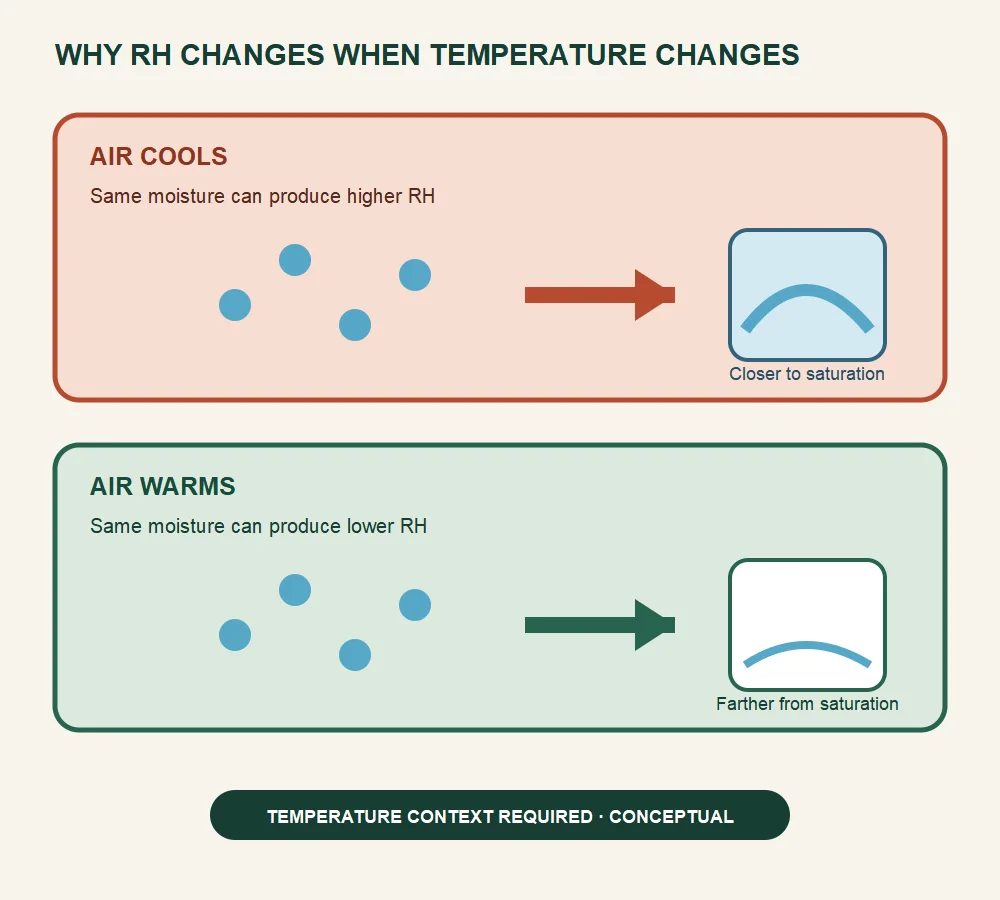
Relative humidity describes how close air is to saturation at its current temperature. UMass Amherst Extension explains that RH changes as air temperature changes. Warm the same air and its RH can fall; cool it and RH can rise, even when no water vapor has been added or removed.
That is why one RH reading cannot identify the cause by itself. A rising nighttime RH may reflect cooling air, continued evaporation, closed vents, or several factors together. A falling daytime RH may reflect warming rather than successful moisture removal.
Record temperature and RH together. If possible, compare more than one crop-height location and note outdoor conditions at the same time. Use the temperature sensor placement guide when location bias may distort the reading. A sensor beside a heater, wet pad, open vent, direct sun patch, cold wall, or fan discharge may not represent the occupied greenhouse.
Use dew point to understand condensation risk
Dew point is the temperature at which air reaches saturation. UF/IFAS explains that condensation forms when greenhouse air contacts a surface below its dew point. Glazing, framing, pipes, leaves, and other surfaces can be colder than the nearby air, especially overnight.
For humidity control, the practical question is not only “What is the RH?” It is also “Which surfaces are cold enough for this air to condense?” Raising air or surface temperature can reduce immediate condensation risk, but warming alone does not remove water vapor. If the moisture stays in a closed greenhouse, risk can return as temperatures fall again.
Map where greenhouse moisture comes from
- Plants and growing media: transpiration and evaporation add water vapor.
- Irrigation: wet foliage, overspray, leaks, and saturated media extend evaporation.
- Floors and drainage: puddles, wet gravel, standing water, and poor drainage keep releasing moisture.
- Outside air: ventilation can either reduce or add moisture depending on outdoor conditions and temperature.
- Combustion or equipment faults: some problems require exact equipment inspection and qualified service rather than an editorial checklist.
Do not assume plants are the only source. Walk the structure and log what is wet, when watering occurred, whether drainage cleared, which vents or fans operated, and when RH changed. Timing often reveals more than a single peak reading.
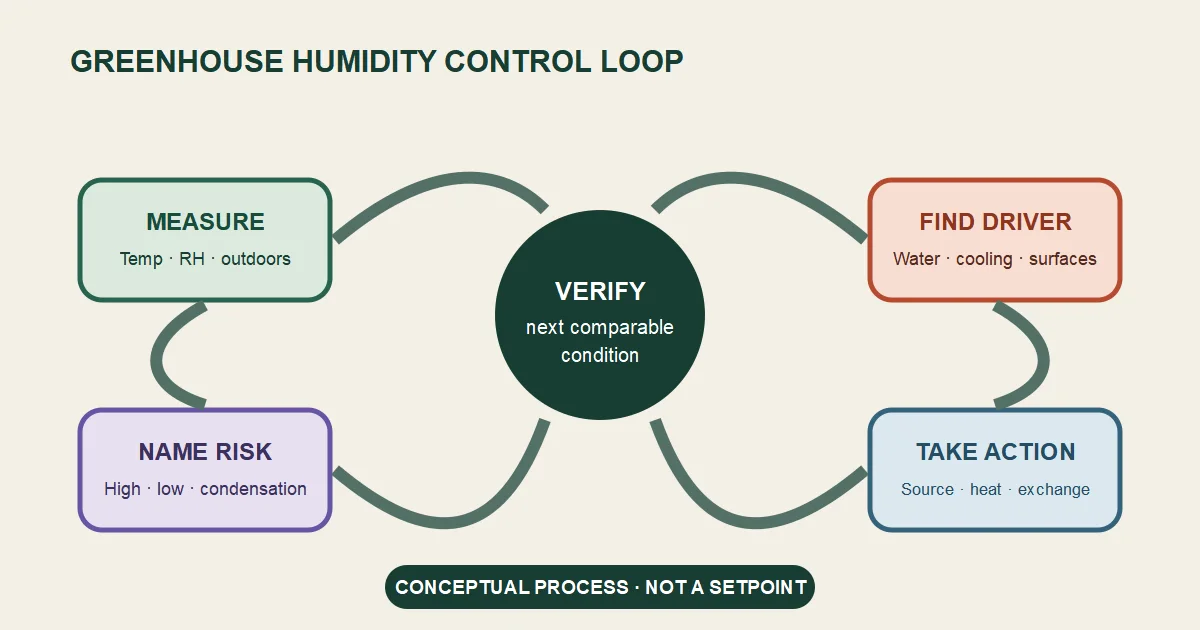
Follow the Greenhouse Humidity Control Loop
- Measure representative conditions. Record crop-height temperature and RH, outdoor temperature and humidity, time, weather, watering, vent/fan state, and visible wet surfaces.
- Name the immediate risk. Separate widespread high RH, condensation on cold surfaces, localized stagnant pockets, and excessively dry air. They do not require the same response.
- Identify the driver. Check temperature change, irrigation timing, wet floors, crop load, closed openings, restricted airflow, and outdoor-air usefulness.
- Choose one bounded action. Reduce an avoidable moisture source, improve drainage, warm cold air or surfaces, exchange air when useful, redistribute air, or reduce an unnecessary drying action.
- Verify under comparable conditions. Review the next similar night, watering event, or weather period. Do not credit a change when outdoor conditions also changed dramatically.
This loop prevents two common errors: reacting to RH without temperature context and changing several controls at once so the useful action cannot be identified. For the broader cross-season feedback loop, continue to the greenhouse temperature control guide.
Choose the first action from the pattern
| Observed pattern | Likely system question | First checks | Important limit |
|---|---|---|---|
| RH climbs after late watering and stays high overnight | Is avoidable moisture entering too late? | Watering time, wet foliage, drainage, puddles, media saturation, overnight temperature | Do not change crop irrigation needs from this guide alone |
| RH rises mainly as temperature falls | Is cooling driving air toward saturation? | Temperature/RH trend, cold surfaces, heat timing, vent state | Heating lowers RH but does not remove water vapor |
| Widespread moisture persists while outdoor air is drier in moisture terms | Can controlled exchange remove moisture? | Outdoor conditions, inlet/outlet path, fan or vent state, restrictions, heating capacity | Cold-air exchange can increase heating demand |
| One corner stays damp while greenhouse average looks acceptable | Is distribution poor? | Crop canopy, benches, curtains, obstructions, circulation coverage, sensor location | Mixing cannot remove net moisture from a closed structure |
| Air becomes too dry during sunny or heavily ventilated periods | Is drying exceeding the crop/system need? | Ventilation stage, heating, shading, watering, sensor exposure, outdoor dryness | No universal minimum RH or crop target applies |
| Fogging or evaporative cooling raises RH without enough cooling | Is outdoor air already too humid or exchange inadequate? | Outdoor humidity, equipment state, ventilation path, sensor placement | Evaporative performance is weather- and equipment-dependent |
Reduce excess humidity at the source
UMass greenhouse best-management guidance emphasizes practices such as watering early enough for surfaces to dry, maintaining drainage, and avoiding standing water. These actions reduce avoidable evaporation without requiring a fan to remove moisture that did not need to enter the air.
- Repair leaks and eliminate persistent puddles.
- Keep drains and floor paths working.
- Direct water toward the root zone rather than wetting unnecessary surfaces.
- Review irrigation timing against overnight closure and temperature drop.
- Separate crop water requirements from preventable overspray or runoff.
Do not reduce irrigation solely to lower RH without checking crop and media needs. Moisture-source control means removing avoidable water, not withholding required water.
Coordinate heating, ventilation, and circulation
These controls perform different jobs. Heating raises air and surface temperatures. Ventilation replaces greenhouse air with outside air. Internal air circulation mixes air inside the structure and can reduce stagnant pockets. UMass describes coordinated heating and venting as a humidity-management approach, not a promise that either control works alone under every condition.
Before venting for moisture, compare indoor and outdoor conditions. Cold outside air can contain less moisture even when its RH looks high; after entering and warming, it may accept more water vapor. Warm humid outside air may offer little drying. This comparison is better handled with temperature, RH, and ideally dew point or humidity-ratio data rather than RH percentages alone.
A circulation fan does not substitute for moisture exchange. Use the circulation fan versus exhaust fan guide when the missing airflow job is unclear, and the greenhouse ventilation guide for the complete intake-to-outlet system.
Respond to air that is too dry
Low RH can result from warm air, dry outdoor air, high ventilation, heating, low plant or media moisture, or sensor exposure. First confirm the reading and crop-zone location. Then inspect which drying actions are active before adding moisture.
UF/IFAS explains that evaporative cooling adds water vapor while cooling air, and that effectiveness depends strongly on outdoor humidity and system conditions. Fogging, misting, wet pads, or other moisture-adding equipment can create new wet-surface and control problems when applied without a complete design.
- Check sensor calibration and placement before reacting.
- Review whether ventilation or heat stages are running longer than intended.
- Confirm irrigation and media moisture meet crop requirements.
- Use shading or cooling decisions only within their own evidence and design constraints.
- Do not add a humidifier or fog system without current equipment instructions, water-quality requirements, sanitation planning, and electrical review.
Build a useful humidity log
| Record | Why it matters |
|---|---|
| Date, time, and weather | Separates system behavior from changing outdoor conditions |
| Indoor temperature and RH at crop height | Keeps RH tied to temperature and occupied-zone conditions |
| Outdoor temperature and RH | Shows whether outside air may help dry or may add moisture |
| Watering time and duration | Connects moisture input with later peaks |
| Vent, exhaust, heat, and circulation state | Shows which control jobs were operating |
| Wet surfaces or condensation locations | Identifies sources and cold-surface patterns |
| Action and next comparable result | Tests one change instead of guessing from one reading |
Stop before changing equipment when key evidence is missing
- The sensor location or calibration is unknown.
- Indoor readings are not paired with temperature and outdoor conditions.
- You cannot identify watering, leaks, drainage, or wet-surface sources.
- The vent, fan, heater, or control sequence is unknown.
- The proposed change affects combustion, electrical equipment, structural openings, water treatment, sanitation, or code requirements.
- The decision depends on crop-specific humidity or disease guidance outside this article’s scope.
Use current manufacturer instructions and qualified help for heating, electrical, automation, structural, or water-system changes. This article provides a diagnosis framework, not an installation specification.
Humidity-control summary
- Read temperature and RH together.
- Use dew point to understand cold-surface condensation risk.
- Reduce avoidable moisture before trying to exhaust it.
- Vent only after considering outdoor air and heating cost.
- Use circulation for distribution, not net moisture removal.
- Confirm low-humidity readings before adding water vapor.
- Change one bounded factor and verify the next comparable event.
Sources and methodology
This research-based pillar synthesizes UMass Amherst Extension and UF/IFAS Extension guidance. The Humidity Control Loop and action matrix are editorial decision tools derived from temperature, moisture, dew-point, ventilation, and circulation principles. No original greenhouse measurement, crop trial, equipment test, installation, ownership, or disease evaluation supports this article.