On this page
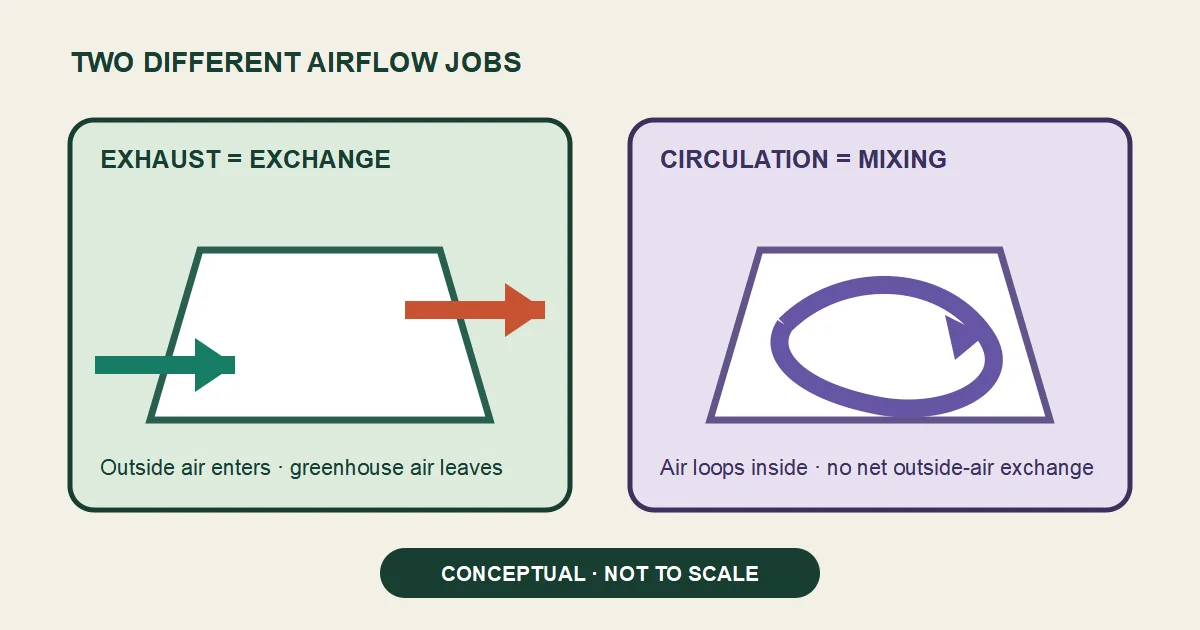
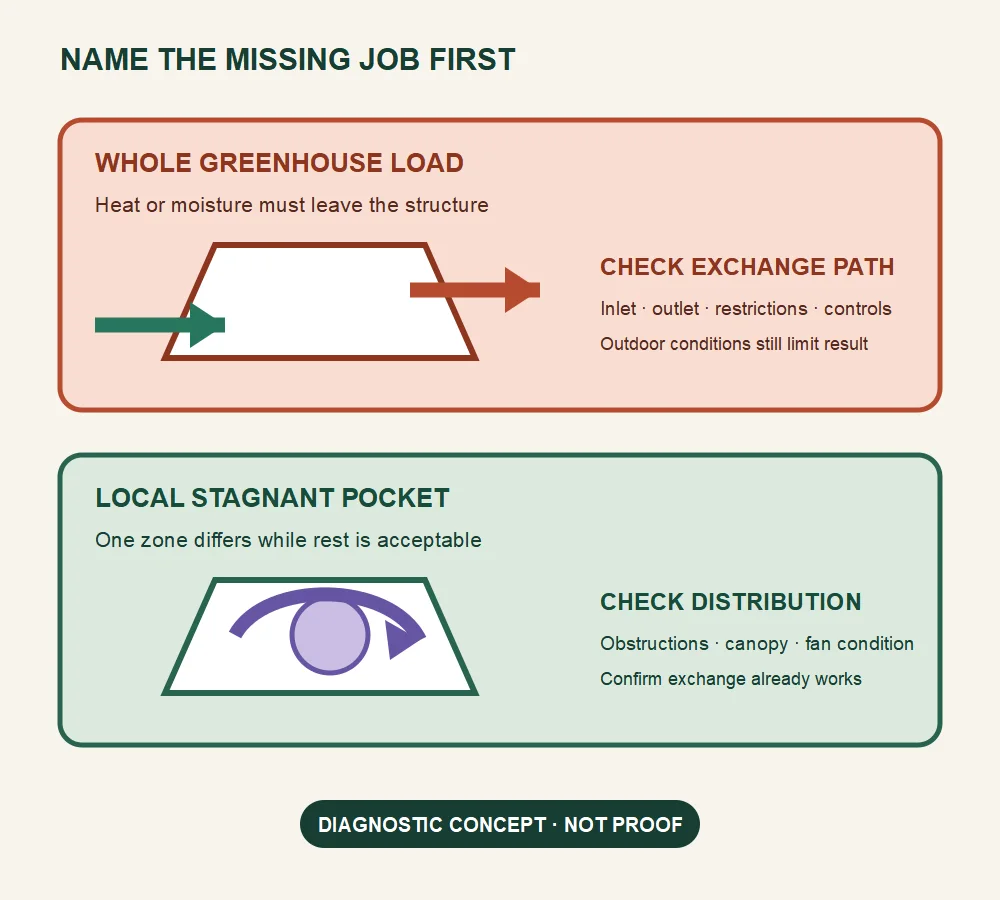
An exhaust fan exchanges greenhouse air with outdoors; a circulation fan mixes air already inside. If heat or moisture needs to leave the structure, check the complete exchange path. If conditions differ mainly from one pocket or bench area to another, internal distribution may be the missing job. Many greenhouses need both, but adding one type does not perform the other type’s work.
This guide helps classify the missing airflow job. It does not calculate exhaust CFM, prescribe fan count or mounting positions, provide wiring instructions, or promise a temperature or humidity result. For the complete system, start with the greenhouse ventilation guide.
Exhaust fans move air out
UF/IFAS defines greenhouse ventilation as removing air from inside and replacing it with outside air. In a powered system, an exhaust fan creates that outward flow while replacement air enters through vents, louvers, doors, or another planned inlet. This job can remove accumulated heat and moisture when outdoor conditions and system capacity allow.
The fan is only one part of the exchange path. Farm Energy’s greenhouse ventilation guidance describes powered airflow as a fan-and-inlet system; closed shutters, dirty screens, restricted louvers, blocked openings, or an inadequate intake can limit flow. A greenhouse that stays hot does not automatically need a larger exhaust fan; it may first need the existing fan, inlet, outlet, controls, and air path checked together.
Ventilation also has an environmental limit. UF/IFAS notes that daytime ventilation alone cannot make greenhouse air cooler than outdoor air. If outside air is already too warm or moisture-laden for the goal, more exchange may not produce the result a reader expects.
Circulation fans move air within the greenhouse
A circulation fan, including a horizontal-airflow fan, redistributes air already in the structure. UMass Amherst Extension’s horizontal-airflow guidance treats this as greenhouse air circulation. Its job is to reduce isolated stagnant zones and improve mixing around the growing area. It can help when one location repeatedly differs from another, but it does not create a net route for greenhouse heat or moisture to leave. When that is the missing job, trace the internal air path before changing equipment.
That distinction matters during diagnosis. Air moving past leaves can feel active while the greenhouse as a whole remains too hot or humid. Visible movement near a circulation fan is not evidence that outside air is entering, crossing the crop zone, and leaving.
Do not infer a universal fan count, spacing, airspeed, or operating schedule from this comparison. Greenhouse geometry, crops, benches, curtains, vents, heaters, controls, and exact equipment instructions change the appropriate arrangement.
Symptom-to-Missing-Job Matrix
| What you observe | First job to investigate | Why | Check before buying |
|---|---|---|---|
| Most of the greenhouse overheats while outdoor air is cooler | Outside-air exchange | Heat must leave and replacement air must cross the structure | Fan operation, inlet opening, shutters, screens, restrictions, controls, and air path |
| Condensation or moisture remains widespread when outdoor air could accept moisture | Outside-air exchange, then distribution | Moist greenhouse air needs an exit; mixing alone does not remove its moisture | Outdoor conditions, vent or fan operation, intake path, heating strategy, and cold surfaces |
| One corner or bench zone is consistently stagnant while the rest is acceptable | Internal circulation | The problem appears local rather than whole-house | Obstructions, crop canopy, curtains, fan condition, and whether exchange already works |
| Air moves strongly near a fan, but the far end stays hot | Diagnose both jobs | Local movement may exist without a complete exchange path | Where air enters, which zones it crosses, where it leaves, and whether flow shortcuts |
| Exhaust fan runs but shutters barely open or doors pull hard | Exchange-path restriction | The fan may lack usable replacement-air area | Exact inlet assembly, component state, free-area evidence, blockage, and fan data |
| Conditions vary mainly between fan cycles | Controls plus circulation | Exchange may remove the load during operation while pockets develop between cycles | Sensor location, control staging, circulation behavior, and representative measurements |
The matrix identifies a first investigation, not a component verdict. A symptom can have several causes. Record indoor and outdoor conditions at the same time, then inspect the actual path before changing equipment. For widespread moisture or changing RH, use the greenhouse humidity control guide to check sources, temperature, dew-point risk, and outdoor-air conditions.
When a greenhouse needs both jobs
Exchange and circulation are complementary. Exhaust or passive openings can remove heat and moisture from the structure. Internal circulation can reduce local pockets while that exchange occurs and during periods when outside-air flow is low. The useful question is not “Which fan is better?” but “Which job is missing under this condition?”
- Exchange without useful distribution: outside air may take a short route from inlet to outlet while parts of the crop zone remain poorly served.
- Distribution without exchange: greenhouse air may be well mixed while total heat or moisture continues accumulating.
- Both jobs present but poorly controlled: sensors, stages, shutters, or vents may operate at the wrong time or from an unrepresentative reading.
- Both jobs working but outdoor conditions limiting: ventilation cannot cool below outdoor air temperature, and humid outdoor air may offer little drying potential.
For a powered system, use the greenhouse fan sizing guide for exhaust demand, the exhaust fan placement guide for the cross-greenhouse path, and the intake vent sizing guide for inlet evidence. If the greenhouse relies mainly on vents or roll-up sides, use the passive greenhouse ventilation guide.
Use a two-question field check
- Does air need to leave? Compare representative indoor and outdoor temperature and moisture conditions. If the greenhouse-wide load must be removed, inspect the outside-air exchange path.
- Does air need to reach a neglected zone? Compare several crop-height locations rather than judging conditions beside one fan or sensor. If the main difference is local, inspect internal distribution and obstructions.
Then verify what is physically operating. Confirm vents and shutters reach their intended positions, screens and guards are clean, inlets are not blocked, fan blades and motors appear serviceable, and controls respond to representative conditions. If a thermostat or controller starts the fan, use the fan thermostat compatibility checklist to confirm the documented control path. Use current manufacturer documentation for exact equipment behavior.
Stop before changing equipment when evidence is missing
- You cannot identify where replacement air enters or where it leaves.
- You have not compared indoor conditions with outdoor conditions at the same time.
- The existing fan model, rated performance, control sequence, or component state is unknown.
- Screens, shutters, louvers, curtains, plants, or stored items may be restricting the path.
- The proposed change affects framing, electrical equipment, wet-location suitability, controls, or required clearances.
Do not use this comparison as mounting, wiring, structural, or code guidance. Follow current instructions for the exact equipment and obtain qualified help when the work or local requirements demand it.
Decision summary
- Choose the exchange path to investigate when heat or moisture must leave the greenhouse as a whole.
- Choose internal circulation to investigate when the main problem is a localized stagnant or uneven pocket.
- Investigate both when air moves near a fan but conditions remain poor elsewhere or between cycles.
- Check limits before buying because intake restrictions, controls, outdoor weather, and equipment data can change the correct next action.
Sources and methodology
This research-based comparison synthesizes Extension guidance on greenhouse ventilation and horizontal air circulation. The diagnostic matrix is editorial decision support derived from the different physical jobs described by the sources. No original greenhouse test, airflow measurement, installation, product evaluation, or ownership experience supports this article.