On this page
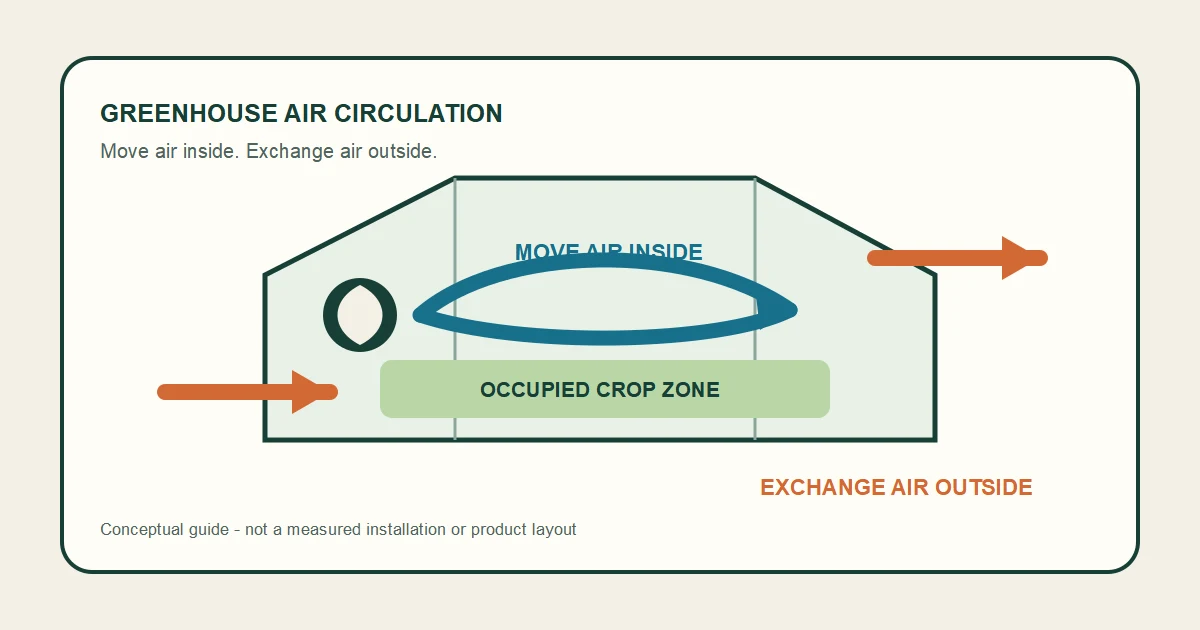
Greenhouse air circulation moves air within the structure; ventilation exchanges greenhouse air with outdoors. If one corner stays still while the rest of the greenhouse behaves normally, trace the internal path first. If heat or moisture is building across the whole structure, use the greenhouse ventilation troubleshooting guide to inspect outside-air exchange, restrictions, controls, and outdoor conditions instead of expecting another circulation fan to remove the load.
This guide focuses on internal distribution: how to follow the air through the occupied crop zone, find a shortcut or blockage, and know when circulation is not the missing job. It does not prescribe a universal fan count, spacing, airspeed, runtime, or product.
Greenhouse air circulation and ventilation solve different problems
Horizontal air flow guidance from UMass Amherst Extension treats circulation as movement within the greenhouse. By contrast, UF/IFAS Extension describes ventilation as replacing inside air with outside air. The distinction matters because moving the same air around cannot create a net path for heat or water vapor to leave.
| What you observe | First job to inspect | Why |
|---|---|---|
| One corner, bench end, or canopy pocket feels still | Internal circulation path | The problem may be local distribution rather than whole-structure exchange. |
| Heat is high across most of the greenhouse | Outside-air exchange and solar load | Internal mixing does not remove a whole-house heat load. |
| Moisture or condensation is widespread | Moisture sources, temperature, exchange, and controls | Circulation redistributes air but does not remove net moisture. |
| Exhaust runs but nearby air seems to take a short route | Intake, outlet, restrictions, and competing openings | The exchange path may bypass the occupied zone. |
| Conditions vary locally after exchange is working | Internal circulation and obstructions | The remaining problem may be how air reaches and returns from the crop zone. |
If the missing job is still unclear, use the circulation versus exhaust fan guide before changing equipment. For the complete system context, start with the greenhouse ventilation guide.
Use the Internal Air Path Trace
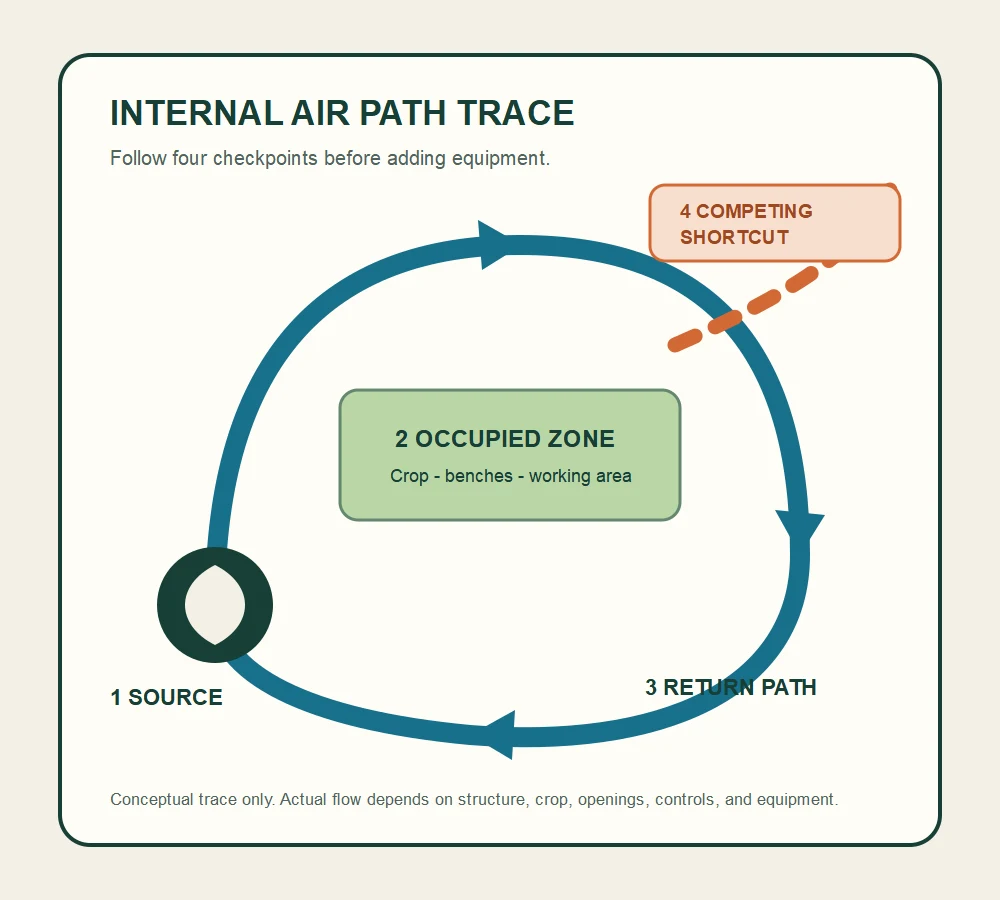
Do not stop at “the fan is running.” A running fan proves that its blades turn; it does not prove useful air reaches the occupied zone. Trace one conceptual loop through four checkpoints.
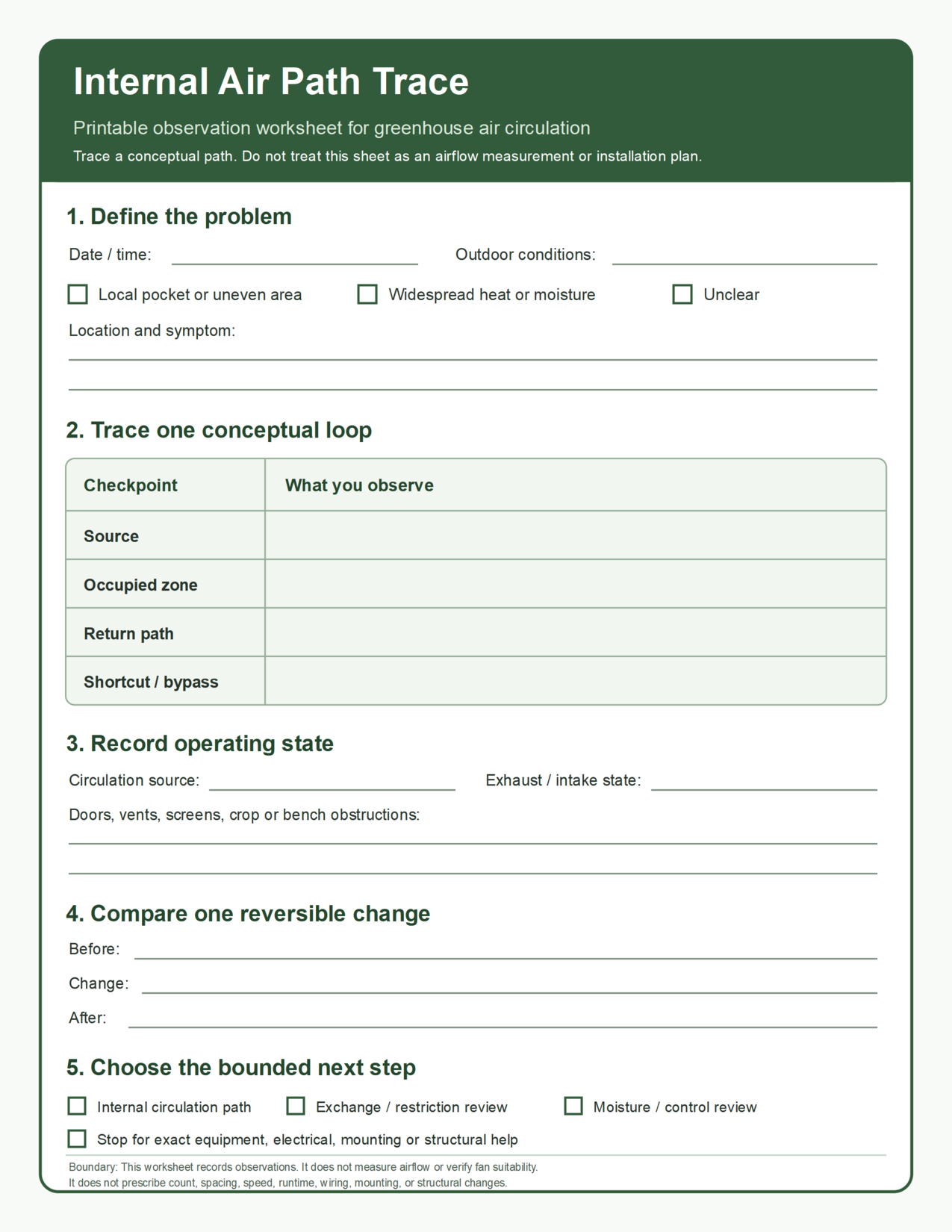
Use the printable worksheet below if you want to record the same four checkpoints, operating state, and one reversible comparison on paper. It organizes observations; it does not measure airflow, verify fan suitability, or prescribe count, spacing, speed, runtime, wiring, mounting, or structural changes.
1. Source: where does the moving air begin?
Identify the circulation source and the direction it is intended to start. Do not assume the label side, grille shape, or mounting appearance proves the delivered direction. Use current equipment instructions when exact fan orientation matters.
2. Occupied zone: does air cross the plants and benches that matter?
Follow the path through the space where leaves, benches, hanging baskets, or propagation areas create resistance. Air that travels above, below, or beside the occupied zone may leave a local pocket even though movement is obvious elsewhere.
3. Return path: can air complete a loop?
A circulation concept needs a return route. Look for a continuous path back toward the source rather than a strong jet that ends against dense crop, plastic, a wall, stored materials, or a closed partition. This is a diagnostic trace, not proof of a specific velocity or volume.
4. Competing shortcut: where can air bypass the occupied zone?
Open doors, large gaps, empty aisles, solid bench fronts, curtains, and nearby exhaust or intake openings can create easier routes. A visible shortcut does not automatically mean it is harmful, but it gives you a specific condition to compare instead of adding equipment blindly.
Check the path without pretending you measured airflow
Start with observation, not a claimed measurement. Compare plant-safe indicators at several locations while keeping doors, vents, curtains, and fans in a recorded state. The purpose is to find relative differences and repeatable shortcuts, not to publish an airspeed result from an improvised test.
- Record which circulation, exhaust, intake, and passive openings are active.
- Choose one suspected stagnant area and one area that appears to move normally.
- Trace the conceptual loop through source, occupied zone, return path, and shortcut.
- Change one reversible condition, such as removing a temporary obstruction or restoring the intended opening state.
- Compare the same locations again under similar operating conditions.
- Stop if the next step requires electrical work, structural change, unsupported mounting, or guessing about equipment orientation.
A small comparison log is more useful than a vague impression. Record time, outdoor conditions, vent and door state, fan state, crop or bench obstruction, and what changed. Keep the conclusion bounded: “this shortcut changed the local pattern” is different from claiming a measured or guaranteed airflow improvement.
Common circulation failures and the next check
| Failure pattern | What it may mean | Next check |
|---|---|---|
| Strong movement near the fan, little movement in the crop zone | Jet bypasses or ends before useful distribution | Trace occupied-zone and return-path checkpoints. |
| One dense crop block stays still | Canopy or bench arrangement interrupts the loop | Compare obstruction state without making unsafe structural changes. |
| Fan points toward an open door or large gap | Air may take a competing shortcut | Record opening state and compare the intended path. |
| Whole greenhouse remains hot | Net heat removal or solar-load problem | Review exchange, intake restrictions, shade, controls, and outdoor limit. |
| Condensation remains widespread | Moisture-source, temperature, dew-point, or exchange problem | Use the greenhouse humidity control guide. |
| Exhaust airflow is the identified missing job | Circulation diagnosis is complete | Move to the greenhouse fan sizing guide only when exchange is the correct next step. |
When circulation is not the answer
Farm Energy Extension describes mechanical ventilation as an exhaust-and-inlet system. If the whole greenhouse needs heat or moisture removed, inspect that exchange system, its restrictions, controls, and outdoor conditions. Adding internal mixing cannot substitute for a usable inlet and outlet path.
Humidity control also depends on more than air movement. UMass Amherst Extension treats air movement alongside temperature, watering, drainage, and ventilation. Circulation may reduce a local stagnant pocket, but it does not prove that water vapor has left the greenhouse.
Stop and use exact current documentation or qualified help when the next action involves electrical work, wet-location suitability, structural mounting, guarding, clearance, wiring, circuit capacity, or modification of a greenhouse frame. This article does not establish product compatibility or installation safety.
A practical circulation decision
If the problem is local, trace the internal loop and remove a proven obstruction or shortcut before adding equipment. If the problem is widespread heat or moisture, shift to exchange, source, temperature, control, and outdoor-condition checks. If both jobs are weak, treat them as separate parts of one system rather than expecting one fan to perform both.
Sources and methodology
This research-based guide uses university and Extension sources on horizontal air flow, greenhouse ventilation, and humidity control. My Greenhouse Lab did not test fans, measure airspeed, inspect a reader greenhouse, or verify a universal layout. The Internal Air Path Trace is an editorial diagnostic framework built from the supported distinction between internal circulation and outside-air exchange.