On this page
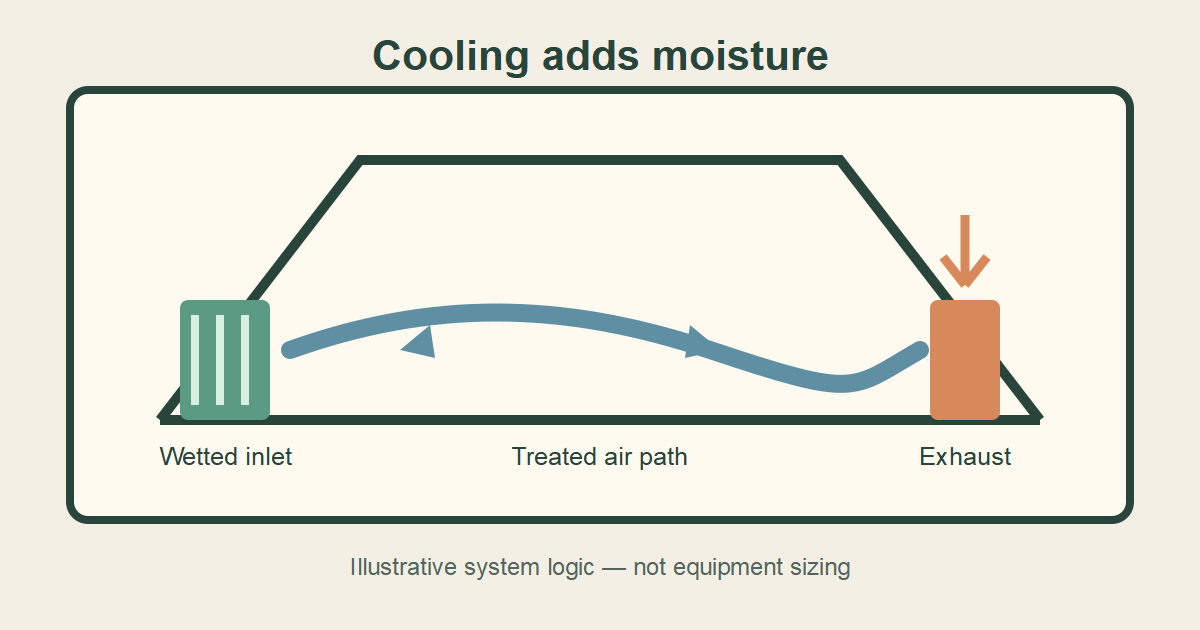
Greenhouse evaporative cooling can lower incoming-air temperature, but it also adds moisture. It is more promising when the entering air is relatively dry and the greenhouse has a deliberate path from wetted inlet to exhaust. Before buying equipment, record outdoor and inside temperature and relative humidity during the hottest period, plus shade and ventilation state. Those observations support a try, measure first, or stop decision; no single humidity cutoff or promised temperature drop applies to every greenhouse.
What evaporative cooling changes
Evaporative cooling moves heat from air into the process of turning liquid water into water vapor. The air can leave the wetted surface cooler, but it also leaves with more moisture. UF/IFAS Extension explains this relationship through dry-bulb and wet-bulb conditions: the available difference between them indicates how much evaporative potential exists under the entering-air conditions.
For a hobby greenhouse decision, the useful lesson is not a universal formula. Drier entering air usually offers more cooling potential; humid entering air offers less. Actual results also depend on solar load, airflow, system design, wetting uniformity, greenhouse length and obstructions. This guide therefore screens suitability; it does not predict an exact indoor temperature.
Measure conditions before choosing greenhouse evaporative cooling
Measure during the period when heat is causing the decision, not only early in the morning. Use outdoor readings near the greenhouse air inlet but protected from direct sun and obvious heat sources. Take inside readings in representative plant-zone air rather than against glazing, in direct sun, or inside a concentrated fan stream.
- Record outdoor temperature and relative humidity.
- Record inside temperature and relative humidity at the same time.
- Note whether shade is deployed and which vents, doors, fans or louvers are operating.
- Describe the heat pattern: whole-house heat, one hot end, strong inlet draft, stagnant center, or rapid cycling.
- Repeat the observation on more than one representative hot period before treating one reading as the normal pattern.
If readings may be distorted by sensor placement, use the temperature sensor placement guide before comparing cooling options. This observation process does not calculate wet-bulb temperature or equipment capacity. It establishes whether the basic conditions and air path deserve further design work.
Check shade and ventilation before adding water
Evaporative equipment should not hide a simpler system problem. If solar gain is still uncontrolled, review the broader summer greenhouse cooling sequence. If shade is appropriate but material area is unknown, use the shade cloth area calculator.
Then inspect the air-exchange path. A fan-and-pad system depends on air entering through the wetted pad, crossing the occupied greenhouse space and leaving through the exhaust. Air that bypasses the pad through open doors, gaps or another intake will not receive the same treatment. Shelving, dense foliage and partitions can also leave uneven zones even when the fan operates.
UF/IFAS greenhouse ventilation guidance treats ventilation as the baseline process for removing heat and moisture, while evaporative cooling becomes relevant when a design needs incoming air cooler than outdoor dry-bulb air. The greenhouse ventilation guide covers the complete inlet, path, outlet and control sequence. This article does not size that system.
Fan-and-pad versus mist or fog
| Method | Decision advantage | Decision concern | Stop before proceeding when |
|---|---|---|---|
| Fan and wetted pad | Creates a defined treated-air inlet and exhaust path | Requires compatible airflow, even wetting, water management and maintenance | Air can bypass the pad, exhaust path is unknown, or design data are missing |
| Mist or fog | Can distribute water into the greenhouse airstream without a full wetted wall | Distribution, droplet behavior, wet surfaces, mineral deposits, clogging and controls depend on system design | Added moisture or wetting is unacceptable, water quality is unknown, or droplets cannot evaporate before reaching surfaces |
University of Connecticut Extension describes fan-and-pad and fog approaches as systems with different distribution and operating tradeoffs. Choice should follow measured conditions and complete system documentation, not a claim that one method is universally better.
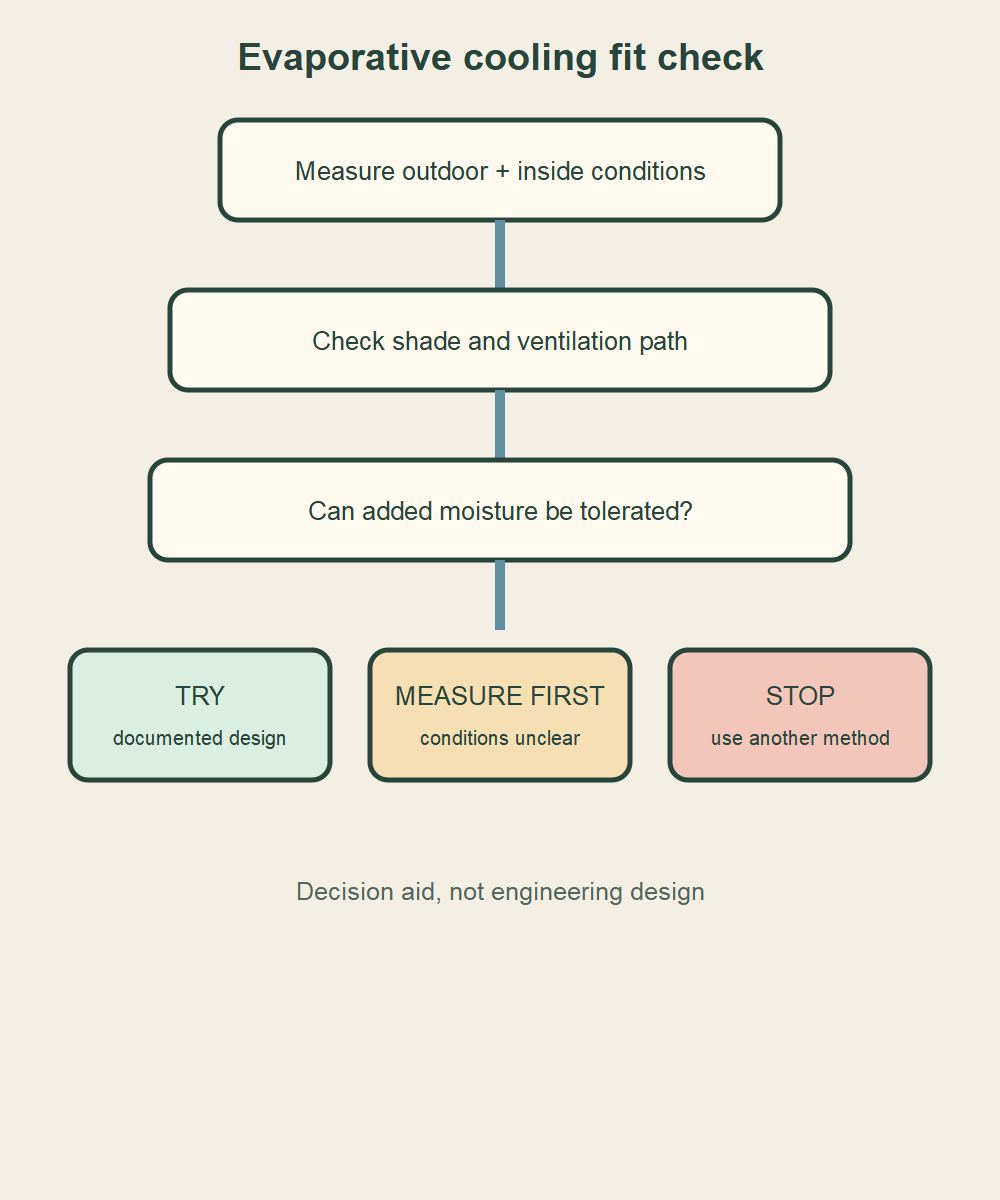
Evaporative-cooling suitability decision tree
TRY: conditions justify a bounded evaluation
- Representative hot-period measurements show entering air has meaningful evaporative potential rather than already being moisture-laden.
- Shade and ordinary ventilation have been checked rather than skipped.
- A deliberate inlet-to-exhaust path can move treated air through the greenhouse.
- Added humidity is acceptable for the intended use and can be monitored.
- Current manufacturer or qualified design information covers equipment, water, electrical, structural and maintenance requirements.
Next action: evaluate a documented system using measured entering-air conditions. Treat any predicted result as conditional, then verify actual temperature, RH and distribution after commissioning.
MEASURE FIRST: basic suitability is still unclear
- Only inside temperature is known; outdoor temperature and RH were not recorded.
- Readings came from direct sun, hot glazing, a fan stream or another unrepresentative location.
- Shade, vent, louver, door or fan state changed between comparisons.
- The greenhouse has uneven hot zones, bypass openings or unknown exhaust performance.
- Water quality, maintenance capacity or moisture tolerance has not been considered.
Next action: complete the observation worksheet across representative hot periods. Fix obvious shade or air-path problems before asking water-based cooling to compensate for them.
STOP / USE ANOTHER METHOD: current conditions do not support this path
- Incoming air is already humid enough that remaining evaporative potential is small for the desired outcome.
- Added moisture conflicts with the greenhouse condition or cannot be monitored and removed.
- The air path cannot be defined, or untreated air will bypass the cooling medium.
- The system would require unsupported wiring, structural modification or water work.
- A seller provides a guaranteed temperature drop without tying it to entering-air conditions and complete system design.
Next action: return to shade, ventilation, airflow-path correction or the broader staged greenhouse temperature-control framework. Do not add moisture merely because the greenhouse is hot.
Observation worksheet
Use one row for each representative hot-period observation. Blank fields mean the decision remains incomplete; they are not permission to estimate a favorable answer.
| Date and time | Outdoor temp / RH | Inside temp / RH | Shade state | Ventilation state | Heat pattern | Moisture or maintenance concern | Decision |
|---|---|---|---|---|---|---|---|
| ____ | ____ / ____ | ____ / ____ | ____ | ____ | ____ | ____ | TRY / MEASURE FIRST / STOP |
| ____ | ____ / ____ | ____ / ____ | ____ | ____ | ____ | ____ | TRY / MEASURE FIRST / STOP |
| ____ | ____ / ____ | ____ / ____ | ____ | ____ | ____ | ____ | TRY / MEASURE FIRST / STOP |
Limits and safety boundary
This guide cannot determine pad area, fan airflow, pump capacity, nozzle pressure, water consumption, electrical protection, structural support or safe installation. Water and electrical equipment require compatible listings, manufacturer instructions, local requirements and qualified help where needed. Stop when documentation is missing or when the proposed work exceeds safe homeowner-level inspection.
If evaporative cooling raises greenhouse humidity or creates wet surfaces, use the greenhouse humidity control guide to assess the broader moisture system. Do not infer that evaporative cooling prevents plant disease or solves condensation.
Sources and methodology
This is a research-based decision guide, not a hands-on equipment test. It synthesizes university Extension guidance on evaporation, wet-bulb and dry-bulb conditions, humidity limits, fan-and-pad airflow, ventilation and fog/mist tradeoffs. The `TRY / MEASURE FIRST / STOP` labels and worksheet are editorial tools for organizing those conditions; they are not engineering standards or validated performance models.