On this page
Quick answer: Use the temperature sensor placement guide when a summer reading may reflect sun, roof, or equipment airflow rather than plant-level air. To cool a greenhouse in summer, first confirm when and where heat builds, then reduce solar gain, restore a complete intake-to-exhaust path, and correct stagnant crop-zone air. Ventilation can move indoor temperature toward outdoor temperature, but it cannot cool below outdoor dry-bulb temperature by air exchange alone. Use evaporative cooling only when local humidity and wet-bulb conditions leave useful cooling potential.
A larger fan is not automatically the first fix. If sunlight keeps adding heat, the intake is restricted, air shortcuts above the plants, or the outdoor air is already very hot and humid, more nominal airflow may produce little useful improvement.
Start by measuring the summer heat pattern
Compare greenhouse and outdoor temperature at the same times, especially before the heat rise, near the hottest period, and as conditions recover. Record shade position, vent openings, exhaust status, intake response, circulation status, and whether doors were opened manually. One peak reading cannot show which part of the cooling chain failed.
| Observed pattern | Most useful next check | What not to assume |
|---|---|---|
| Temperature climbs soon after direct sun reaches the cover | Solar gain, shade placement, and uncovered roof or wall area | Fan size is automatically the root cause |
| Exhaust runs but doors pull inward or shutters open weakly | Intake free area and obstructions | The fan delivers its rated airflow in the installed system |
| Air near the roof clears but the crop zone stays hot | Air path, short-circuiting, and circulation through plants | Whole-house temperature is uniform |
| Indoor temperature stays only slightly above very hot outdoor air | Outdoor dry-bulb limit and whether another cooling process is justified | More ventilation can cool below outdoor temperature |
| Evaporative equipment runs with little temperature change | Outdoor humidity, wet-bulb depression, pad wetting, bypass, and maintenance | Evaporation provides the same cooling in every climate |
Follow the Summer Cooling Escalation Ladder
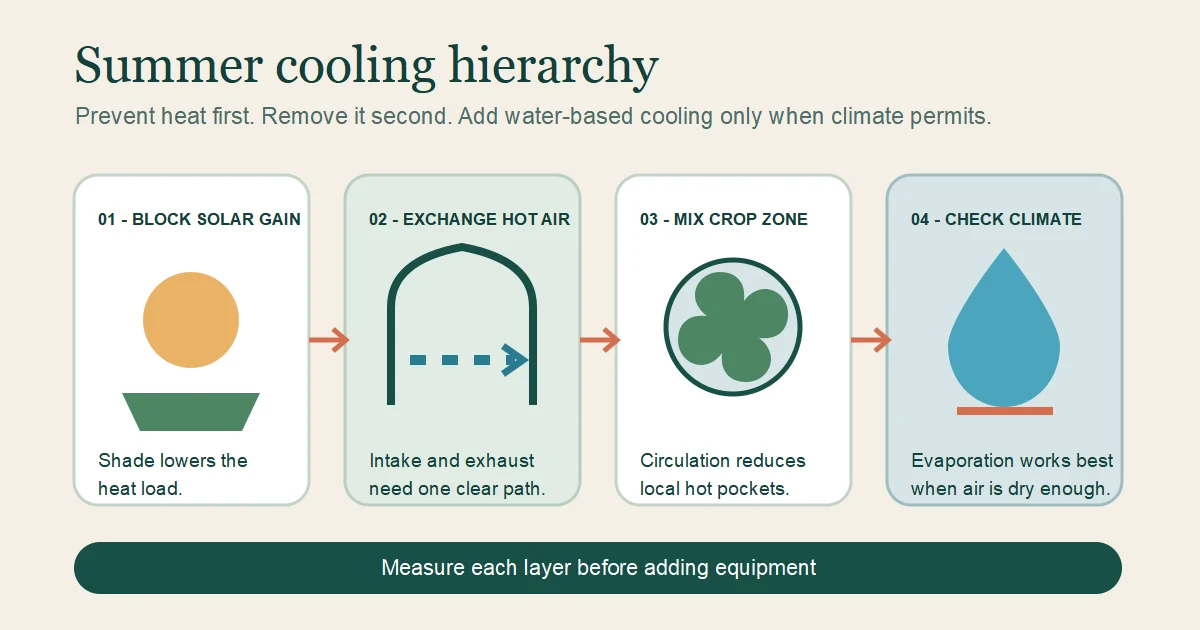
The sequence below moves from preventing heat to removing it, then to climate-dependent cooling. A greenhouse may need several layers, but each layer should have a defined job.
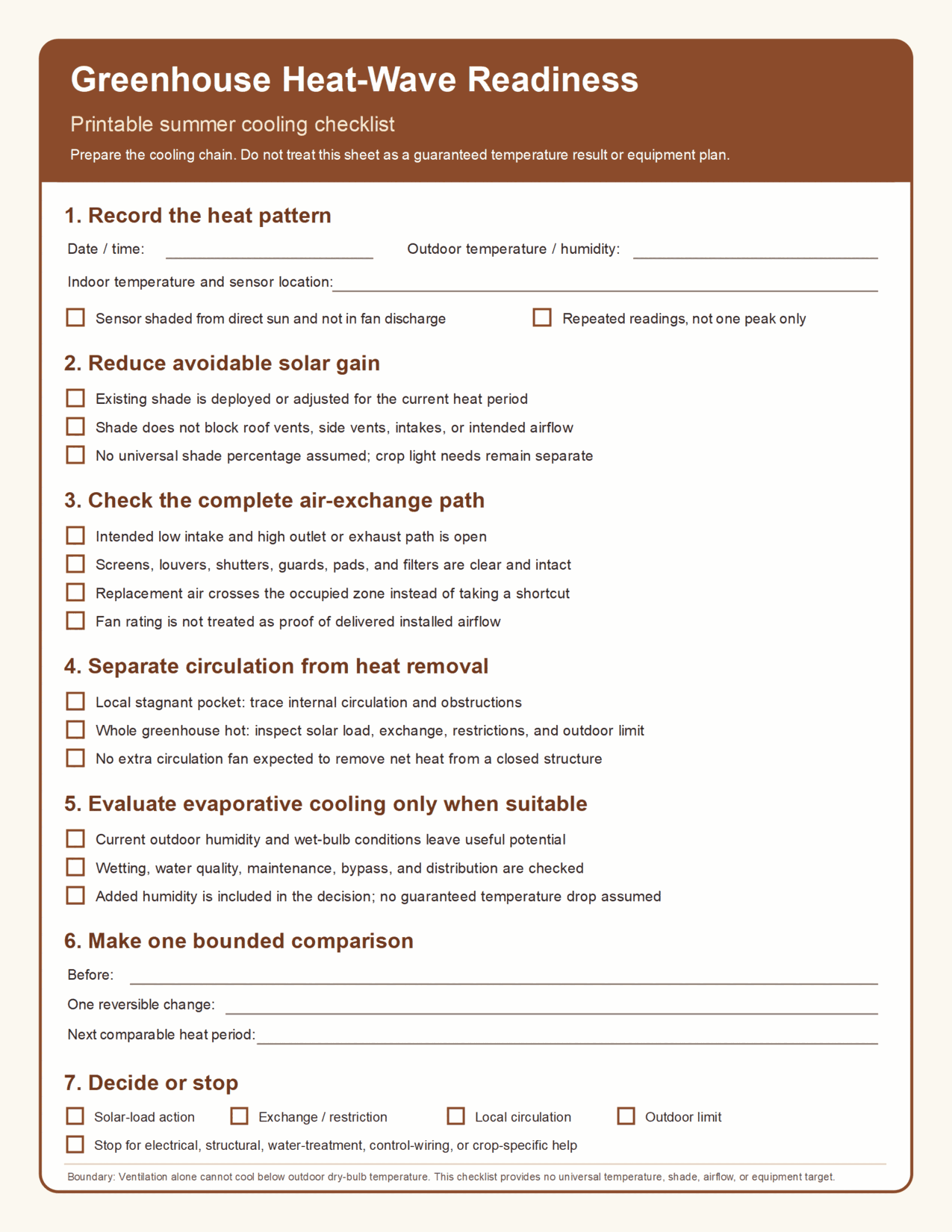
Use the printable heat-wave readiness checklist before a forecast hot period or a repeat overheating event. It follows the same sequence and preserves the article’s limits: it does not guarantee a temperature result or provide a universal temperature, shade, airflow, or equipment target.
1. Reduce solar heat before trying to remove it
Shading lowers the solar energy entering or being absorbed by the greenhouse. UMass Extension includes porous shade systems among the cooling measures that may be needed on hot, sunny days. Exterior shade can intercept radiation before it enters the structure; interior shade can still reduce radiation reaching plants, but some absorbed heat remains inside.
There is no single correct shade percentage for every greenhouse. Material, placement, crop light needs, season, latitude, glazing, and local solar intensity change the decision. After choosing a material, use the shade-cloth area calculator to estimate rectangular coverage without treating the cloth percentage as a temperature forecast. Use a removable or adjustable approach where seasonal light demand changes, and verify that shade does not block vents or disrupt the intended airflow path.
2. Open a complete ventilation path
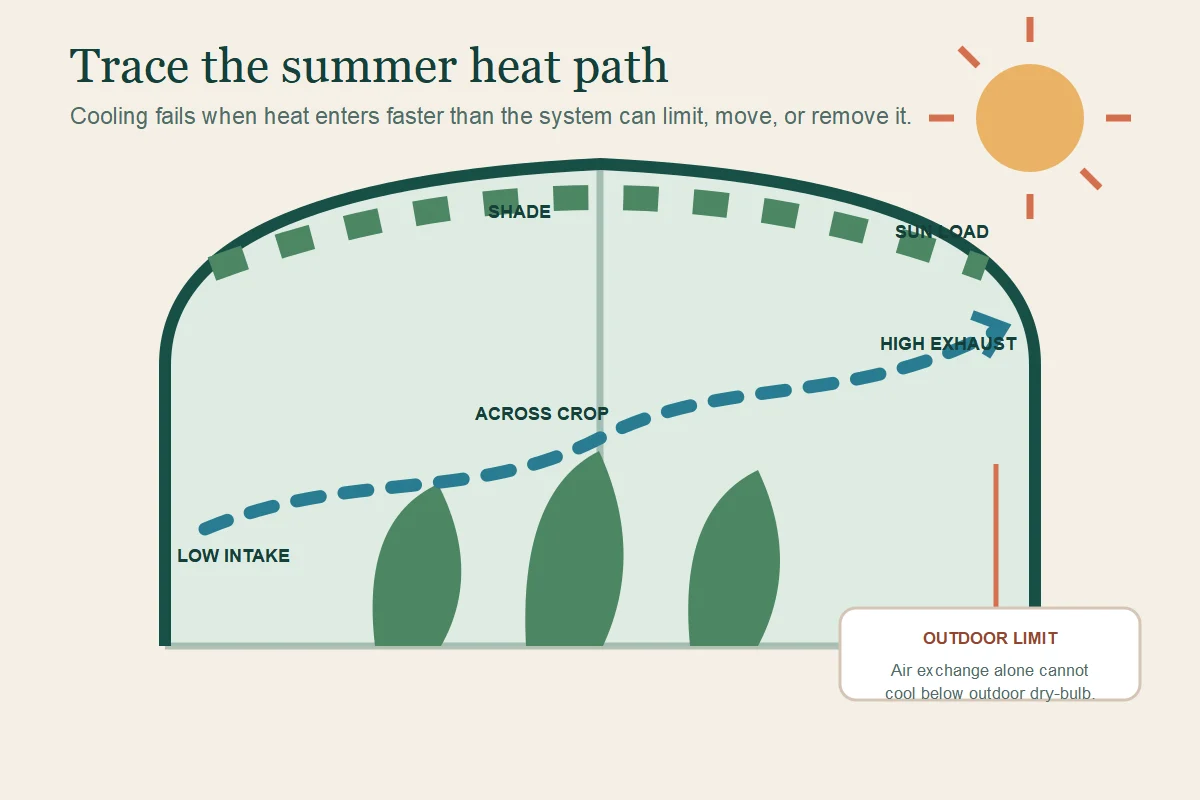
Hot air must leave, and replacement air must enter without excessive restriction. Natural ventilation relies on wind and buoyancy through suitable side and roof openings; its performance changes with weather, geometry, screens, nearby structures, and obstructions. Mechanical ventilation relies on delivered fan airflow, not the label rating alone.
Use the greenhouse ventilation guide for whole-system roles. If an exhaust system appears starved for replacement air, check the intake vent sizing guide. A restricted intake can reduce delivered flow and pull air through unintended gaps. When several causes remain plausible, troubleshoot the ventilation path before treating fan size as the answer.
3. Move air through the occupied zone
Circulation can reduce local hot pockets, strengthen mixing around foliage, and help the crop zone follow the main exchange path. It does not remove net heat from a closed greenhouse. If the distinction is unclear, use the circulation fan versus exhaust fan guide. If the problem is local and uneven, use the circulation check before changing equipment.
Look for air that enters and immediately exits above or beside the crop, fans that oppose one another, dense foliage or stored materials that block flow, and sensors located in a fan discharge or direct sun patch.
4. Verify delivered airflow before buying more fan
Fan labels do not account for every installed restriction. Screens, shutters, ducting, dirty guards, insufficient intake, pressure, and maintenance can reduce delivered airflow. The greenhouse ventilation calculator can organize a bounded airflow estimate, but it cannot prove installed performance or choose one universal summer target.
Clean and inspect existing components within manufacturer instructions before resizing equipment. Electrical work, structural openings, new controls, and permanent fan installation may require qualified help.
5. Add evaporative cooling only when the climate permits
Evaporative cooling uses water evaporation to lower air temperature while raising moisture content. Its potential depends on the difference between outdoor dry-bulb and wet-bulb temperature. UF/IFAS guidance explains that hot, dry air offers more potential than hot, humid air.
A fan-and-pad or fogging system must also distribute cooled air, avoid excessive bypass, maintain water quality and wetting, and fit the greenhouse air path. Do not infer a guaranteed temperature drop from a general rule or marketing claim. Review the humidity consequence with the greenhouse humidity control guide.
Know the limit of each cooling method
| Method | Primary job | Main limitation |
|---|---|---|
| Shade | Reduces incoming solar load | Too much or poorly placed shade can reduce useful light or obstruct vents |
| Natural ventilation | Uses wind and buoyancy for air exchange | Performance changes with weather, geometry, and obstructions |
| Mechanical exhaust | Provides controlled air exchange | Needs adequate intake and cannot cool below outdoor dry-bulb temperature alone |
| Circulation | Reduces local hot and stagnant pockets | Does not remove net heat from a closed greenhouse |
| Evaporative cooling | Cools air through water evaporation | Limited by outdoor humidity and adds moisture |
Make one bounded change and compare
- Choose two comparable hot days if possible.
- Record indoor and outdoor temperature, time, sun exposure, shade, vent, fan, intake, and circulation state.
- Change one bounded factor, such as deploying existing shade earlier or clearing a confirmed intake obstruction.
- Compare the timing and size of the heat rise, not only one maximum reading.
- Keep the change only if it improves the occupied zone without causing a new light, humidity, or airflow problem.
Weather will not repeat exactly, so this is not a controlled field trial. The log gives practical directional evidence and prevents several simultaneous changes from hiding the useful one.
Stop and inspect before escalating equipment
- The indoor sensor sits in direct sun, beside glazing, or in a fan discharge.
- Outdoor temperature and humidity were not recorded.
- Shade blocks a vent or intake.
- Louvers, guards, screens, pads, or filters are dirty or damaged.
- Doors pull strongly when exhaust starts, suggesting replacement-air restriction.
- Water treatment, electrical changes, structural openings, or control wiring exceed safe homeowner work.
- The decision depends on crop-specific heat or light limits outside this article’s scope.
The practical summer cooling decision
If the greenhouse rises far above outdoor temperature, first look for excessive solar gain or failed air exchange. If it remains only slightly above very hot outdoor air, ventilation may already be near its physical limit; shade or a climate-suitable cooling process matters more than another arbitrary fan increase. Diagnose the layer that is failing, change one factor, and verify the next comparable heat event. Use the greenhouse temperature control guide to carry the same feedback loop into cold nights and shoulder seasons. For a solar-powered fan option, establish required airflow first, then use the solar greenhouse fan planning guide to check energy, timing, and backup assumptions; then use the solar greenhouse fan calculator to test power and daily-energy assumptions without treating them as a cooling guarantee.
Sources and methodology
This article synthesizes university Extension guidance into a summer cooling escalation ladder and diagnostic matrix. These are editorial decision tools derived from solar-load, shading, ventilation, circulation, and evaporative-cooling principles. No original greenhouse measurement, installation, equipment test, crop trial, or owner case supports this article.