On this page
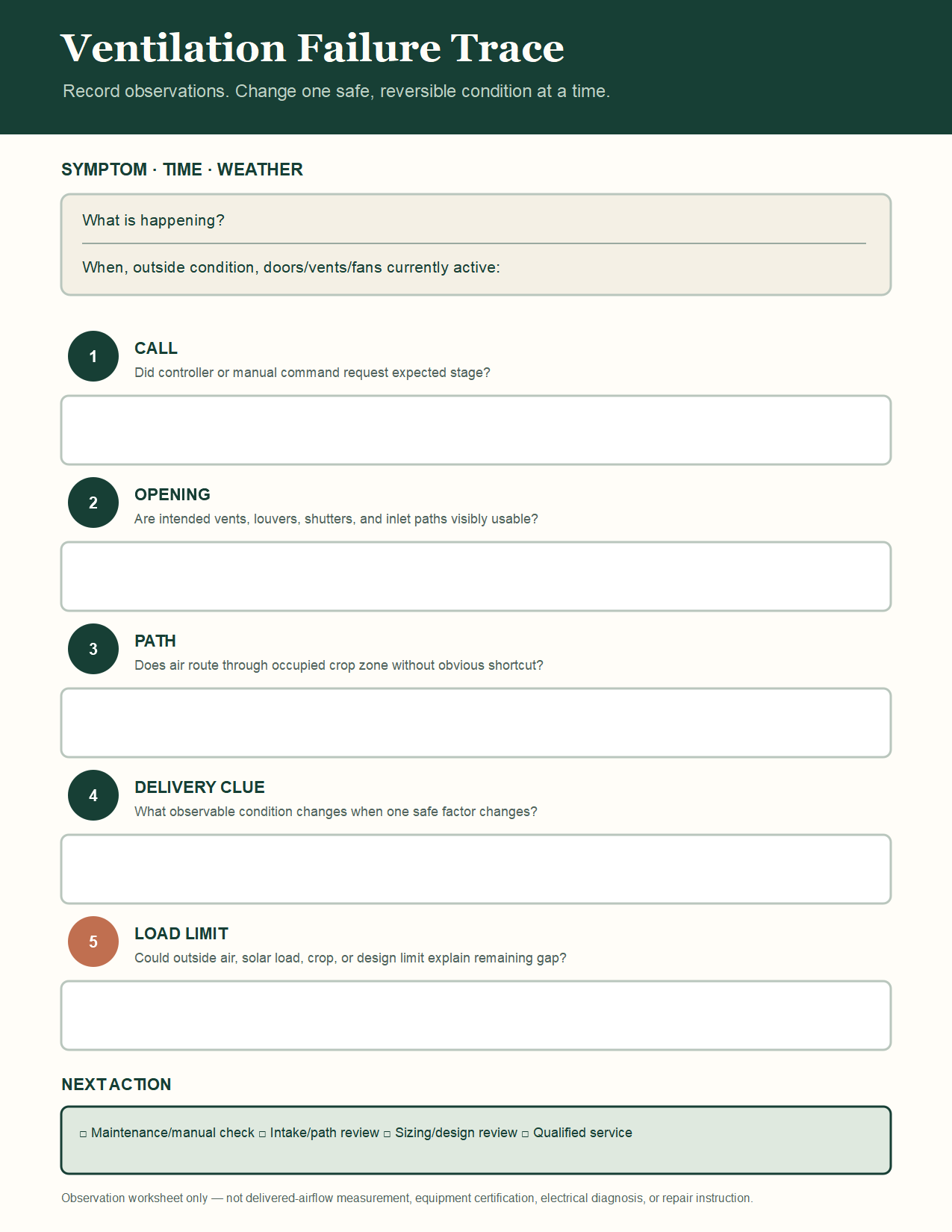
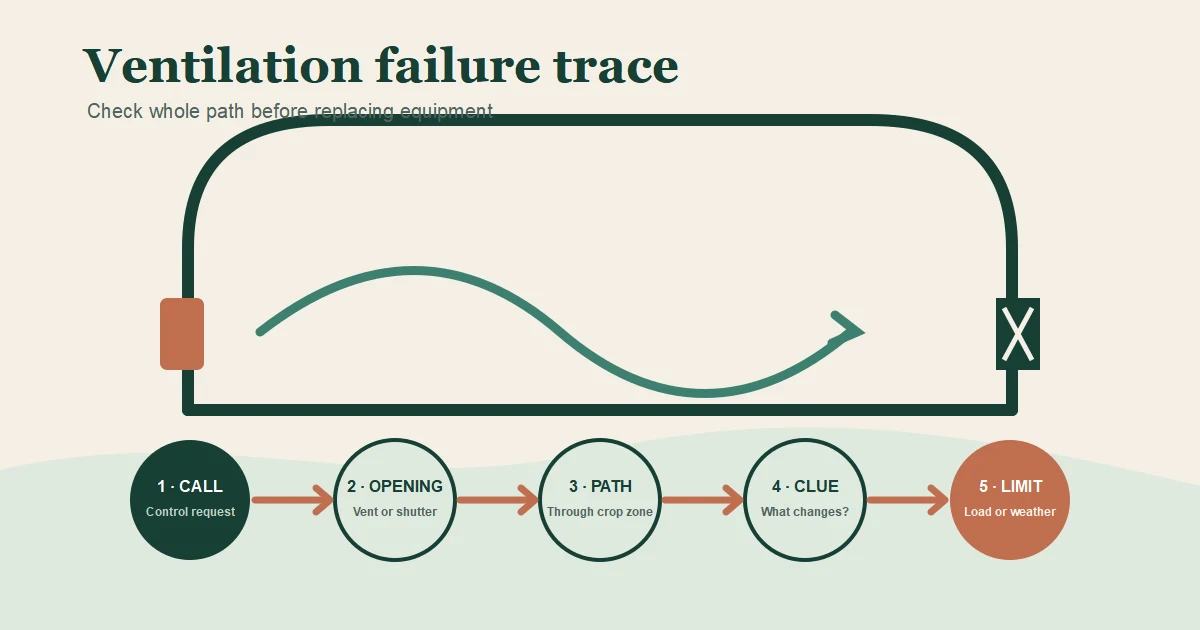
When greenhouse ventilation underperforms, do not replace the fan first. Trace the whole system: control call, opening, intake path, route through the crop zone, delivery clue, and outdoor load. A spinning fan can coexist with restricted replacement air, a partly opened shutter, a bypass path, a control sequence that is not coordinated, or weather that exceeds ventilation-only capacity. Use one safe, reversible observation at a time. Stop before electrical, structural, moving-part, or uncertain-control work.
Quick triage: classify what changed
Record the symptom, time, weather, equipment that appears to be called, opening position, and any unusual sound or vibration. This record helps separate an exchange problem from an internal circulation problem or an outside-load limit. It does not identify a failed component by itself.
- Weak airflow at the exhaust: trace the inlet, shutter, guard, louver, and discharge route before treating the fan rating as the cause.
- Plastic pulls inward or a door resists opening: inspect the replacement-air path and opening sequence without forcing anything. Negative pressure can indicate inadequate intake, delayed opening, or another restriction.
- One area stays still or humid: classify local distribution separately from outside-air exchange. An exhaust system can operate while air bypasses the occupied crop zone.
- Fans run but the greenhouse remains hot: check whether the system is moving outside air through the intended path, then account for outdoor conditions and solar load. Ventilation cannot guarantee indoor temperatures below outdoor conditions.
Ventilation Failure Trace: five checkpoints
This trace is an editorial diagnostic sequence built from extension guidance on complete ventilation paths, intake openings, restrictions, controls, distribution, and weather limits. Source facts are cited beside the relevant checkpoints; the order helps you choose the next observation without declaring a component failed.
1. Call: was the expected operating sequence requested?
Observe the system state from outside the equipment enclosure: which fan, louver, damper, or vent appears active, and whether staged components respond together. A thermostat, sensor, controller, damper, louver, or staged sequence can produce unexpected operation even when one component appears active. Compare the observed sequence with current manufacturer instructions. Do not bypass a control, interlock, alarm, or guard. UMass Extension describes controls, staging, shutters, and ventilation operation.
Disconfirming clue: if the requested sequence and visible opening state match, move to the physical path instead of assuming control failure. Next action: document settings and sequence for manual review or qualified service when behavior is inconsistent, inaccessible, or unsafe.
2. Opening: can replacement air enter?
Check whether the intended intake, shutter, louver, vent, or door is open as designed and free from visible weeds, plastic, stored items, dirt, ice, or other obstruction. Dirty, sticky, bent, uneven, damaged, or partly opened shutters can restrict airflow. Inspect only from a safe position and only as allowed by equipment instructions; do not remove guards or force a moving part. UMass Extension identifies shutter condition and operation as relevant to greenhouse airflow and heat loss.
Plastic pulling tightly inward or a door becoming difficult to open while exhaust equipment runs can indicate inadequate replacement-air opening. That clue narrows the category; it does not prove a specific obstruction, sizing error, or failed motor. UMass Extension discusses negative pressure and intake openings in greenhouse ventilation.
Disconfirming clue: a fully open, visibly clear intake does not end the trace; restriction can exist farther along the path or in installed accessories. Next action: use the greenhouse intake vent sizing guide only after opening and obstruction checks leave an intake-capacity mismatch plausible.
3. Path: does air travel through the intended zone?
Follow the intended route from intake to exhaust: openings, screens, louvers, guards, fan housing, crop canopy, partitions, benches, and discharge. Installed accessories and pressure conditions can make bare-fan or free-air ratings poor proxies for installed airflow. The general rating principle is documented by Penn State Extension’s discussion of rated ventilation fans; its source context is agricultural housing, not proof of performance for a particular greenhouse.
Look for a bypass route that lets air move around the crop zone, a blocked section, or a layout that leaves a stagnant pocket. Do not use a smoke test, airspeed target, or invented loss percentage as a universal diagnostic rule. Exchange and circulation are different jobs: outside-air exchange removes heat and moisture through an inlet-to-exhaust path, while circulation redistributes air within the greenhouse. Compare those jobs in the circulation versus exhaust fan guide and trace local distribution with the greenhouse air circulation guide.
Disconfirming clue: uniform movement through the intended zone makes a simple bypass less likely, but does not prove that installed capacity matches the greenhouse. Next action: review placement in where to place a greenhouse exhaust fan when the route, rather than component operation, remains suspect.
4. Delivery clue: what safe observation shows useful exchange?
Use non-contact clues: visible opening response, discharge direction, movement at a safe distance, changes in local conditions, and whether the expected route remains open. Treat these as clues, not measured airflow. A running motor or spinning blade does not by itself prove that the greenhouse receives expected outside-air exchange. Complete-system guidance from UF/IFAS on greenhouse ventilation and Farm Energy Extension supports checking the full inlet-to-exhaust system.
Disconfirming clue: a discharge clue can be present even when crop-zone distribution is poor, or absent because the observation point is unsuitable. Do not turn a weak clue into a replacement decision. Next action: compare equipment data and installed conditions through the greenhouse fan sizing guide or the greenhouse ventilation calculator only when a capacity mismatch remains plausible after path checks. If replacement remains plausible after that diagnosis, use the greenhouse exhaust fan selection guide.
5. Load limit: is ventilation being asked to do too much?
Ventilation response is bounded by outdoor conditions, solar load, greenhouse geometry, crop density, restrictions, and equipment condition. A system can operate as intended and still fail to produce the indoor result you hoped for when heat load or outdoor air condition is unfavorable. UMass Extension, UF/IFAS, and Farm Energy Extension frame ventilation as a complete system with environmental limits.
Disconfirming clue: if the same symptom persists during different outdoor conditions with the complete path open, load alone becomes a weaker explanation. Next action: review the summer greenhouse cooling sequence before adding equipment or expecting a guaranteed temperature result.
Symptom-to-check decision table
Use this table to choose the next observation. “Likely category” means a group of possible causes, not a diagnosis. Keep the check reversible, visible, and compatible with the manual.
| Symptom | Observable evidence | Likely category | Reversible check | Next guide | Stop condition |
|---|---|---|---|---|---|
| Fan runs, airflow feels weak | Opening partly closed; visible obstruction; weak or altered discharge clue | Opening, restriction, installed-condition, or capacity category | Observe opening and route; clear only accessible, non-energized obstructions allowed by instructions | Intake vent sizing | Guard, moving part, wiring, overheating, or uncertain component access |
| Plastic pulls inward or door resists | Strong inward pull during exhaust operation | Replacement-air or opening-sequence category | Observe intake and shutter response; do not force door or shutter | Intake vent sizing | Structural movement, unsafe access, or pressure behavior that could damage the structure |
| Shutter or vent does not open fully | Dirty, sticky, bent, uneven, obstructed, or inconsistent position | Maintenance, obstruction, hardware, or control category | Compare visible state with manual; clean only within stated safe procedure | Shutter guidance | Electrical behavior, moving-part access, damaged frame, or force required |
| Greenhouse stays hot with fans running | Path may operate, but indoor result remains poor during high solar or outdoor load | Load-limit, restriction, path, or capacity category | Trace call, opening, path, and delivery clue before changing equipment | Summer cooling sequence | Heat damage, alarm condition, overheating equipment, or unsafe shutdown decision |
| One zone stays still or humid | Local stagnant pocket while exchange equipment appears active | Internal distribution or bypass category | Observe route and classify circulation versus exhaust | Air circulation guide | Access requires climbing, moving guards, or structural changes |
| Operation cycles, sounds, or stages inconsistently | Unexpected sequence, noise, vibration, or delayed response | Control, sensor, hardware, or maintenance category | Record conditions and compare with current instructions; do not bypass controls | Ventilation fundamentals | Damaged wiring, overheating, severe vibration, exposed moving parts, or uncertain controls |
Safe stop rules
Stop observation and follow equipment instructions when you find damaged wiring, unexpected electrical behavior, overheating, severe vibration, exposed or inaccessible moving parts, structural movement, or controls you cannot identify confidently. Do not touch energized equipment, remove guards, bypass interlocks or alarms, work at height, alter roof or wall structure, adjust belts, or disassemble a fan. Use qualified service for electrical, structural, or inaccessible mechanical work.
Stop troubleshooting when the next step would require guessing. Record the symptom and operating state instead. A qualified person can use that record without inheriting an unsupported diagnosis.
Sources and methodology
This is research-only guidance. My Greenhouse Lab Editorial Team synthesized land-grant Extension and standards-oriented ventilation material accessed August 16, 2026, then added an explicitly labeled diagnostic sequence to help readers choose reversible observations. No greenhouse ownership, installation, field test, airflow measurement, equipment inspection, product comparison, or repair work is claimed. Source boundaries matter: generic fan ratings are not installed airflow, symptoms do not prove component failure, and no universal setpoint, loss percentage, airspeed, maintenance interval, or cooling outcome is supplied.
- UMass Amherst Extension: Ventilation for Greenhouses
- UF/IFAS Extension: Greenhouse Ventilation
- Farm Energy Extension: Greenhouse Ventilation
- UMass Amherst Extension: Horizontal Air Flow is Best for Greenhouse Air Circulation
- UMass Amherst Extension: Fan Shutter Heat Loss in Greenhouses
- Penn State Extension: Selecting Rated Ventilation Fans